Abstract
Music restoration seeks to recover a clean signal from an observed recording degraded by an unknown
effect, distortion, or corruption.
Existing systems often rely on paired training data and degradation-specific supervision,
which limits their use when the forward process is not known in advance.
We propose LOUDAR (Latent-space Optimization of Unknown Distortion for
Audio Restoration), a
general-purpose restoration method that operates in the latent space of a pretrained audio autoencoder and
models the unknown degradation as a learnable latent operator.
At inference time, LOUDAR alternates between estimating the clean latent variable and
updating the latent operator parameters.
An unconditional latent diffusion model provides a prior over clean audio and regularizes this inference
by steering the latent estimate toward the manifold of clean recordings.
Because the degradation model is adapted per input the approach is broadly applicable across diverse
restoration problems.
We evaluate LOUDAR on singing voice effect removal and restoration,
as well as guitar distortion removal,
and show that it consistently improves over degraded inputs and is competitive with supervised and
unsupervised baselines in waveform and latent domains.
Listening examples
Select an experiment below, then click a cell to play that method's audio for that example in the player below.
Click a cell below to play a clip.
Results
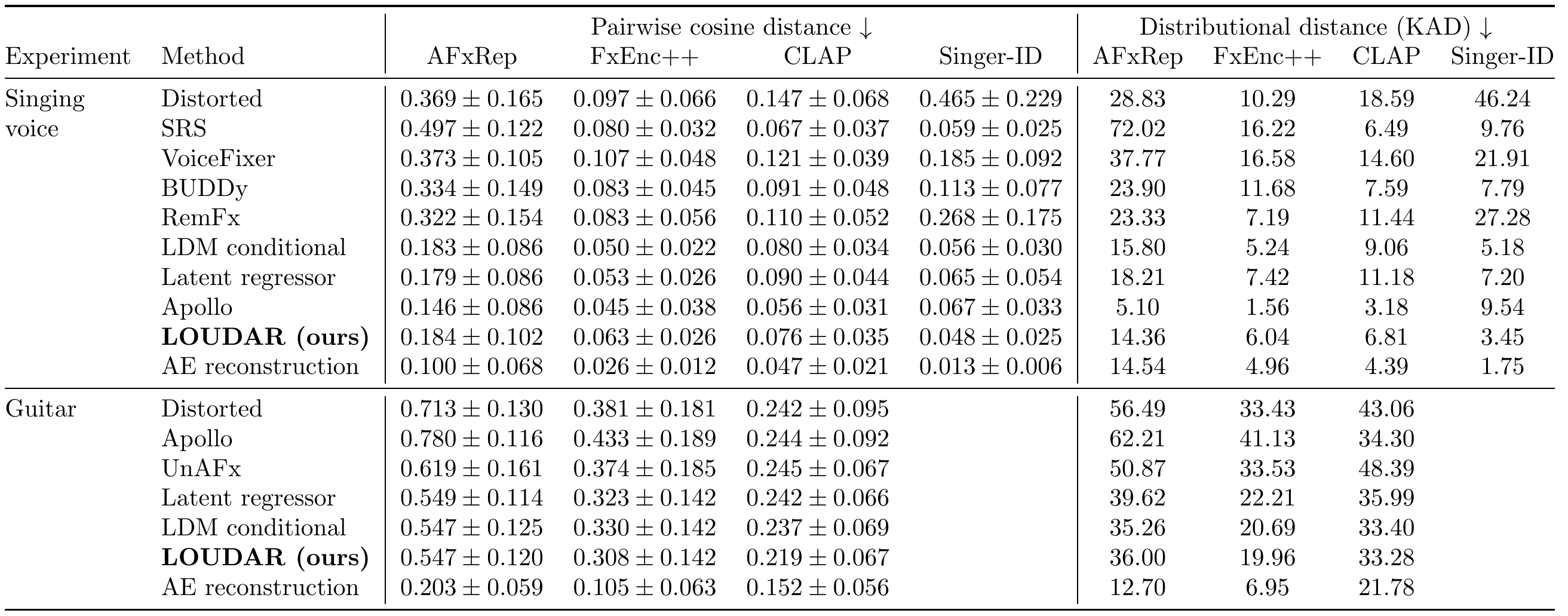
Quantitative comparison of LOUDAR against supervised and unsupervised baselines on singing voice effect removal/restoration and guitar distortion removal, measured by pairwise cosine distance and distributional distance (KAD) across several embedding spaces.
Click an image to zoom in
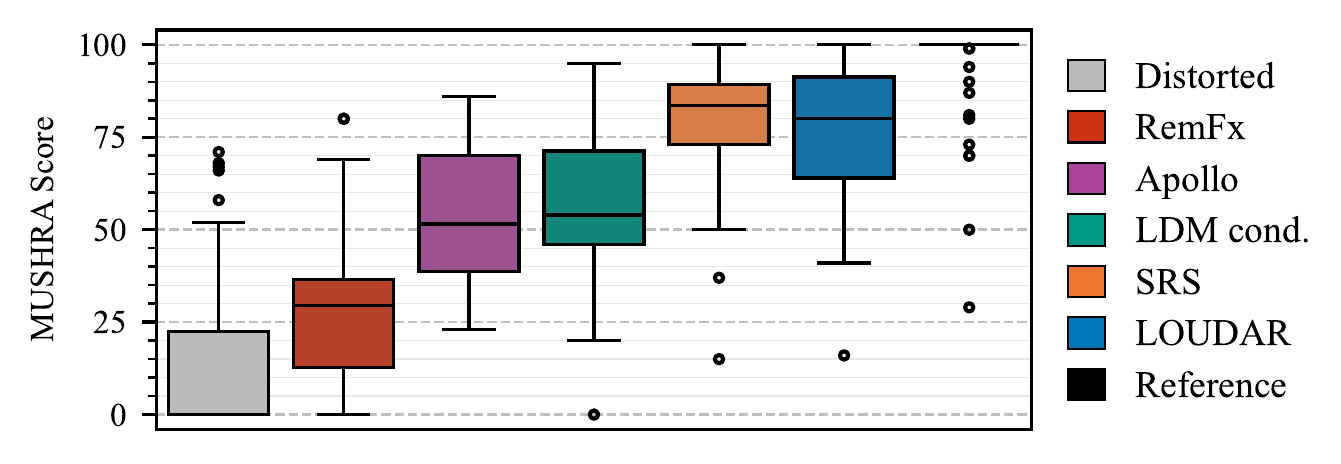
Listening test results — DiffVox
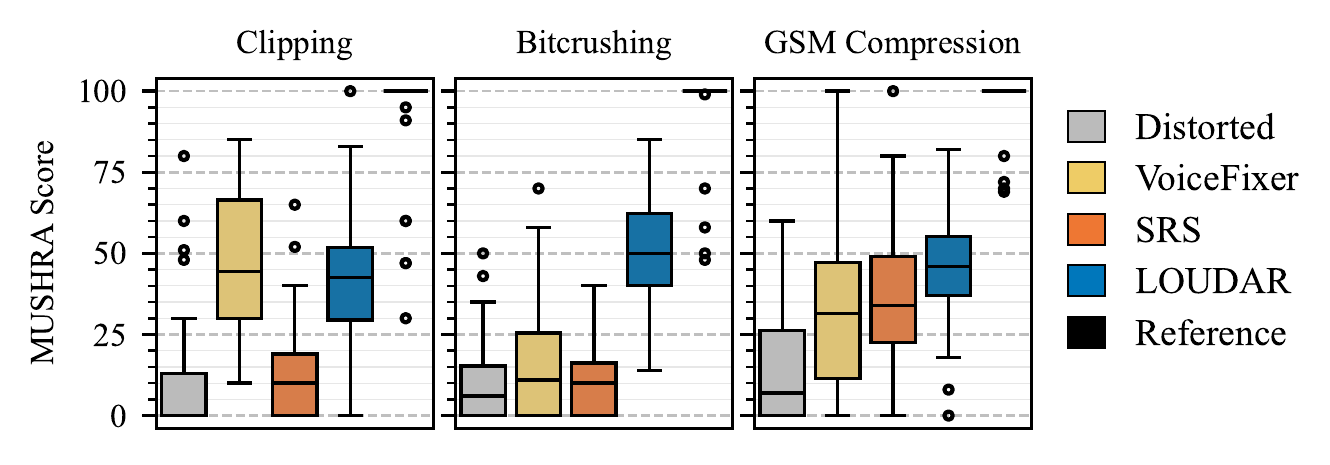
Listening test results — NHSS
BibTeX
@article{Svento2026LOUDAR,
  title={Music Restoration via Latent Operator Optimization and Diffusion Model Priors},
  author={Michal Švento and Eloi Moliner and Valterri Kallinen and Lauri Juvela and Vesa Välimäki and Pavel Rajmic},
  journal={ISMIR 2026},
  year={2026},
}